Monday, August 5, 2013

Self-Checking Clothespin Centers

 I love activities that I can use in centers that are engaging for students and allow them to self-check.  I created these self-checking clothespin centers for very little money, and it was really easy. I took a piece of card stock paper and cut it down the middle to create two separate activities. Using a sharpie, I wrote questions on one side.  The blue center below is an example of an addition center.  I used the sharpie to write answers on a clothespin for each question.  Then I flipped the paper over and wrote the answers next to where the clothespin lines up for each question.  So I have the sums written on both sides of the clothespins.  Students clip clothespins to each number sentence.  When they have finished clipping a clothespin to each question, they flip the card over and check their answers.  Super easy, and students really enjoy doing this activity.


Addition Clothespin Center - There is a letter written on each clothespin because I have more than one of these centers.  The letter denotes to which set the clothespin belongs.

My students enjoyed the clothespin centers so much, I ended up making several for different concepts.  Here is one that I did on green card stock for alphabetizing.  Students start out with a set of clothespins with animal names on it.  They put the pins in alphabetical order next to arrows.  The arrows give them a place to line their clothespins up neatly.  After they believe they have the pins in alphabetical order, they can flip the card over and check to see if they did it correctly. 

Alphabetical Order Clothespin Center - I have several of these alphabetical cards created.  I did these with themes.  The animal names theme is displayed above.  

One of the great things about these centers, besides the fact that they are so cheap and easy to make is that they really engage students.  Students enjoy clipping the clothespins and it is challenging for them to do the activities.  My students will sit and does these for as long as I let them.  Another great aspect is that when students finish, they don't simply say "I'm done! Now what?"  Most of my students will take all the clothespins off and try to do it again to see if they can get faster.  As my students progress, I will let them take a timer with them to the center.  They love it.  :-)

Tuesday, July 30, 2013

Blogging........by students.

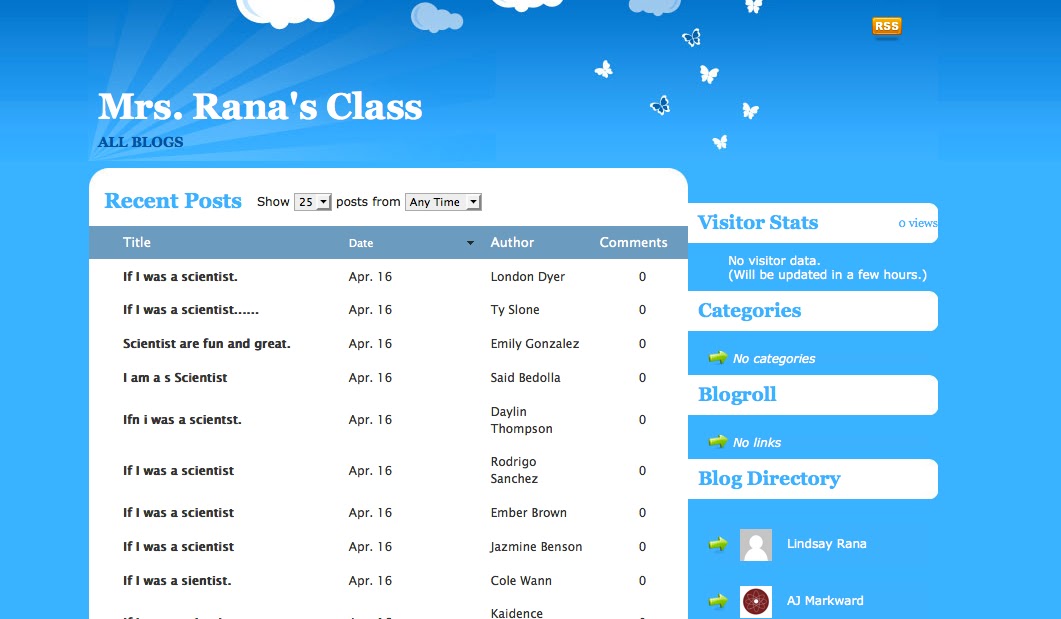
I just want to take a moment to share about a great webservice that I used all last year in my classroom and plan on using this year.  It's called Kidblog.  Kidblog is a FREE, (oh yeah, my favorite four letter word) online blogging site designed especially for teachers to use for their students.  It is a safe environment where teachers have absolute control over content and connections. 


Teachers can create an account without having student email addresses.  It takes as little as a minute to set up a class. Students have the option to customize their blogs if the teacher allows it. My first grade students loved having the opportunity not only to blog, but also to comment on the blogs of their peers. Above is a sample page from one of my students. We started out simple with short one sentence blog posts and ended with students writing weekly blog entries about what they were learning in class.  This was a great review tool for them and assessment tool for me.  I highly recommend this totally FREE website.

Check it out at  www.kidblog.org

Monday, July 29, 2013

Number Sense & Dice Patterns

I just finished participating in the KESAM institute for K-8 Math Teachers.  This eight day workshop covers all areas of math and focuses on how to use concrete models to teach concepts with special attention paid to the five math process skills. One of the great things that I took away from this training was tons of ideas for math centers and activities.

With young students, it is extremely important to develop good number sense.  One of the first things you can do to develop this is to teach students to identify patterns in numbers.  Our adult eyes are quick to identify any object found in groups based upon number patterns we have learned.  For example, look at the two pictures below.  How many ducks?  How many flowers?


I'm willing to bet none of you actually counted the objects in those pictures.  As adults, your mind has learned to identify a pattern of four as well as a pattern of six without counting.  Children have the ability to learn this skill at an early age.  It is a great way to start them on the way to developing number sense.

Dice are a great way to start developing number sense in children.  In my classroom, I begin by teaching students to identify the dice patterns using paper plates.  Much like flashcards, I use paper plates with dots in patterns to play a game called "Name That Number".  Students love it. I progress into students using dice to play the game with each other.  Eventually as students master the ability to identify numbers without counting the dots, I add more than one dice.  Great addition practice as well.

Thursday, July 25, 2013

A Few Math Apps for Primary Grades

Number Rack
This abacus style app promotes students' ability to think in groups of five or ten.  In addition, it gives students concrete models where they can practice basic addition and subtraction concepts. FREE!

 Number Pieces
 I love, love, LOVE this app.  I do quite a bit of math instruction with base ten blocks.  This app is one of the best virtual base ten block apps I have seen.  It allows students to group and ungroup blocks. It offers a writing feature where students can write numbers, use as scratch pad, or even circle blocks to group them. What's my favorite four letter word?? FREE!!


 Geoboard
This is a great app for allowing students to explore shapes, symmetry, and more.  My students really enjoy using this app.  On the ipad, it offers two different sizes of geoboards with five band colors to choose from. Lots of possibilities with this app.  Oh, did I mention....FREE!!!! :-)


Tiny Tips for My Teacher Friends

Storage Solution -
I have rectangular tables in my classroom.  I enjoy having the tables to promote collaborative learning, but it makes storage a problem.  Seatback pockets are very expensive and haven't been something I could afford to do. Last year I saw numerous posts on using stretchable book covers as seatback pockets.  Sometime in September, I decided to purchase some that were on clearance at our local Walmart and try them out.  I have to admit the work fairly well.  Now, I wouldn't recommend putting textbooks in them, but my students were able to keep workbooks, work folders, white boards, and their computer headphones within easy reach. I paid around $1.00 for each cover, and I am happy to say that all but one will be usable again this year. If you decide to try book covers, I recommend purchasing jumbo size covers.  These hold wider folders better.
Brilliant idea!!!
I have seen these tiny latching containers for the past three years at Staples.  I've always wondered what in the world they would be good for besides holding a few paper clips. The other day I was browsing through Staples trying to decide what supplies I needed for the coming year when I stumbled upon these little babies again.  BAM! It hit me right in the forehead.  These would be awesome containers for dice. They latch securely, are the perfect size, and offer great visibility for students to see the dice. They even stack for easy storage. No more flying dice!! I even scored great on their price because they were on sale for .25 cents.  Normally priced at $1.00 a box, I think it is a decent price for such a great solution.

Friday, March 15, 2013

Dodecagons

 First grade has been studying the solar system, and we used a very creative way to display our research - DODECAGONS.  Students were give specific things to research:  The sun, Mercury, Venus, Earth, the Earth's moon, Mars, Jupiter, Saturn, Uranus, Neptune, and the dwarf planet Pluto.  Using non-fiction books and online searches to find information, students filled out 12 sides to the dodecagon and folded and taped it together to form the shape.  Students learned about the etymology of the word dodecagon and compared it to words like hexagon, pentagon, and decagon.  Check out some pictures of various student's dodecagon.
 Sorry, I couldn't get this one to rotate.  :-(


All students chose their own facts to share.  This student found some very interesting information out about Uranus during his discovery research.


I found that the students absorbed so much more information when they had to discover it for themselves.  It was difficult at times to not offer too much assistance and instead, simply scaffold the research process.


Jupiter was a class favorite.  Students had to take turns researching this planet throughout the various activities that we have done so that everyone would get a chance to study it.


Students were given a rubric on how this activity would be assessed.  Guidelines were clearly expressed prior to beginning the task so that students would know what the expectations were to complete this project correctly.   Keep in mind this work was done by 1st graders! I am very proud.

Show Me!

Recently, I began taking part in twitter chats for professional development.  I have to say that if you are a teacher and you are not utilizing this totally free resource for ideas and continued professional growth, you are missing out!  One of my new favorites is a Sunday night chat under the hashtag #1stchat.  It makes it possible to network and collaborate with educators all over the world with a focus on the 1st grade.  The other night, I was really inspired by a program that was shared by another teacher.  The program, or app, is called ShowMe.  It allows students to make a recording of their voice while illustrating or writing whatever they want.  I found this a great tool for assessing students abilities and understanding while also activating higher order thinking skills.  I am now experimenting with how this app can be best used in my classroom to advance my 1st graders. Here is an example of one activity that I have already used this great app to do. The possibilities are endless.